What an absolutely cracking pair of novels, from the 1970s, for young adults. One is a thoroughly enjoyable murder mystery and the other a Gothic timeslip novel.
K. M. Peyton is probably best known for her Flambards series of four novels about orphan Christina Parsons that were televised in 1979. Pony mad children also loved her Fly-by-Night novel and the sequels. A Midsummer Night’s Death continues the story of one of the characters, Jonathan Meredith. It works well as a stand-alone novel however.
Jonathan is a bored sixth former at a boarding school. Able enough and not without the ability to succeed socially if he could be bothered, lazy, climbing-mad Jonathan is caught in a series of increasingly dramatic dilemmas after he witnesses something during the night when a suspicious death occurs amongst the staff.
The writing is incredibly good, taut with the competing tensions of all the trivial-but-magnified things that young people worry about playing out against the realisation for Jonathan that he cannot just ‘opt-out’ of everything any more and that his failure to act could have serious consequences. The characterisation is excellent and Jonathan’s reluctant character development is handled very deftly. He can be hard-headed enough to do the right thing and he is physically brave but he is also also unpleasantly stubborn and selfish. Which side of Jonathan will be the dominant one as the increasing dangers play out?
The murder mystery element is very good and stands up well against crime fiction for adults. It was quite the page turner and I forgot I was reading a young adult novel. There are adult themes (this is very much aimed at young adults not children) and these are mostly also handled well, with the inevitable caveat that some attitudes change over time. Attitudes are not so different though that much of the implied social commentary still resonates today.
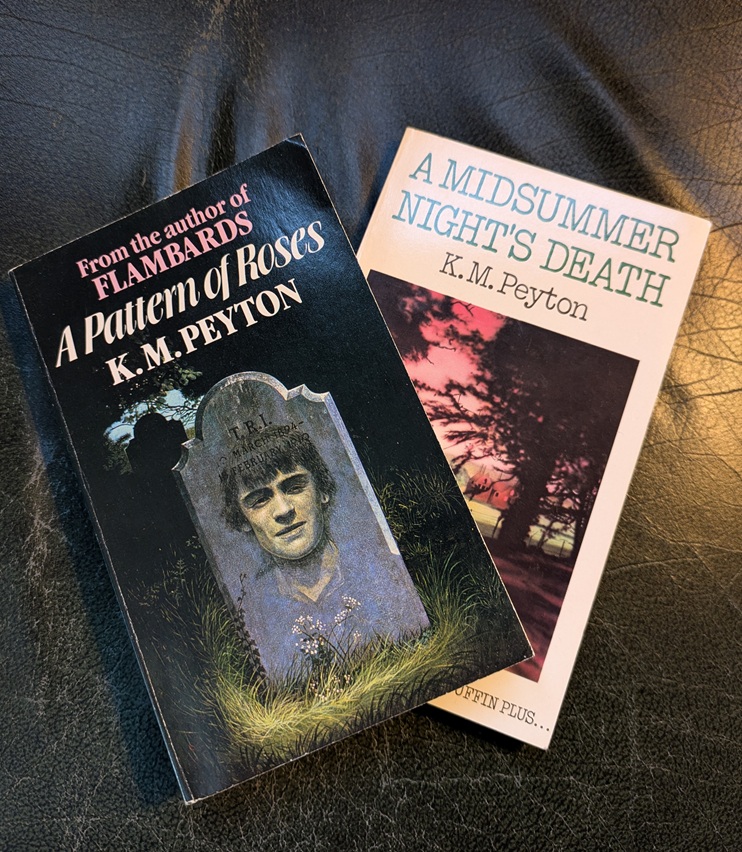
K. M. Peyton has had some lovely book covers notably the beautiful Victor Ambrus illustrations for her Flambards series. She was seriously let down however by the Puffin Plus cover for A Midsummer Night’s Death which is one of the worst I have ever seen.
Far better cover-wise and as equal a page turner is A Pattern of Roses. This is a timeslip novel featuring two boys (one more of a young man) in the same village many decades apart. Sixth-former Tim, in the novel’s present day, has just moved with his family to a cottage in the countryside. His wealthy parents are knocking the old building about to provide a much larger and more fashionnable home and during the building work Tim finds a tin of old drawings. He is convalescing from glandualar fever and is kicking around at home rather than attending his expensive private school. The contents of the tin and the life of the young boy of decades earlier start to become an obsession.
During the course of his investigations Tim starts relcutantly hanging around with Rebecca the vicar’s daughter. Whilst Tim is fussed over (but not listened to) by his wealthy parents, Rebecca, the youngest of a large family, is largely ignored. Her parents and siblings are full of good causes and the zeal of helping others but can’t see the lonely, slightly disorientated girl in their own home. This is something of a Mrs Jellaby situation (Mrs Jellaby has many causes and seriously neglects her own children in Charles Dickens’ Bleak House).
In the parallel story in the Edwardian period we follow working-class country boy Tom as he moves from his school days to the start of his very hard working life. Like Tim he is a talented artist and his worth is spotted by Miss May Bellinger, another vicar’s daughter whose home life is in contrast to Rebecca’s but suffers neglect in her own way too. We see Tom’s hopes and fears and his awkward friendship with Netty, Miss May’s beautiful younger cousin who is very much out of his social class.
As we read there are hints of supernatural mystery but we don’t know what is real or related to Tim’s convalscent, slightly obsessed focus on the puzzle before him. It adds to the mystery and a rather Gothic atmostphere builds. Again, Peyton is excellent at handling tension.
The pace speeds up as the two strands move in greater synchronicity. Again, this young adult novel becomes a page turner.
Social change is most evident in the concept of choice and the contrast between the artifical control of Tim by his parents’ wants (they want him to go into his father’s business) when really if left alone Tim does have choices; and the rather more brutal situation that Tom finds himself in with no choices and the social awkawardness of Miss May’s desire that he should not waste his artistic talent, set against the realities of a life that is bound by twelve-hour days of hard argicultural labour.
The novel’s resolution is not entirely a surprise as we know some aspects of Tim’s story from early on in the book but the resolutions are nontheless satisfying. I also rather liked the dramatic contrast between engaging and irresponisble Netty from the past and dogged and incisive Rebecca in the novel’s present. The book also captures a moment in the 1970s, as the concept of manual work becomes part of a world view that holds that it is a more authentic and almost more ethical way of life compared to business or professional jobs: a growing and instinctive dislike of the corporate or the sense of a ‘company man’. A move to the gentrification of manual labour if you like. Peyton manges to both see it happening and approve of this to an extent, whilst also showing through the parallel Edwardian plot that it is, to use the modern phrase, something of a luxuary belief evolving in the late twentieth century West, to think you can take chances and follow your dream instead of doing the solid job that’s waiting for you. It is only possible with a safety net behind you.
Whilst the end held no great surprise I had galloped towards it in a great unput-downable-rush and was sorry to leave the characters behind as the book ended. If you enjoyed Charlotte Sometimes by Penelope Farmer then you’d almost certainly enjoy this, its older ‘young adult’ cousin.
A Pattern of Roses also benefited from a lovely Victor Ambrus dust jacket when first published. Its later incarnation for Sparrow Books (the edition I read) is not too bad cover-wise either.
*******
The best place for more information about K. M. Peyton (and any pony book author) is Jane Badger Books. There are summaries of most of her books alongside pictures of the covers. Jane has also written an excellent obituary of Peyton which as well as being a lovely summary of a writing life is an incisive piece of literary criticism.
 Juxtabook
Leave a comment